Showing posts with label Minimalism Principles. Show all posts

29 April 2013

Start Slow

Language Development
One of my favorite classes in college was Language Development. It was fascinating to me to learn how children (and adults) learn a language, and learn to speak and understand language. Generally, infants first pick up the sounds of the language most often spoken around them, and they begin to attempt to make these sounds from a very young age... even just a few months. As they get older, they begin to understand some words and commands, and by the end of their first year, most infants can say one or two "words", which may or may not sound like actual words to those outside of their normal circles (ie. to anyone other than parents or grandparents). Technically speaking, the term "infant" refers to those "without language," so a child officially becomes a "toddler" when they start walking, and start talking.

By the middle of the second year, most toddlers can understand the meanings of hundreds of nouns (cookie, cow, chair, garbage, etc), as well as many adjectives (slow, fast, tall, short, blue, etc) and verbs (run, walk, sit, stand, etc) and are beginning to understand more abstract concepts (wait, help, etc). These toddlers are also beginning to string together their own two-three (or more) word sentences.
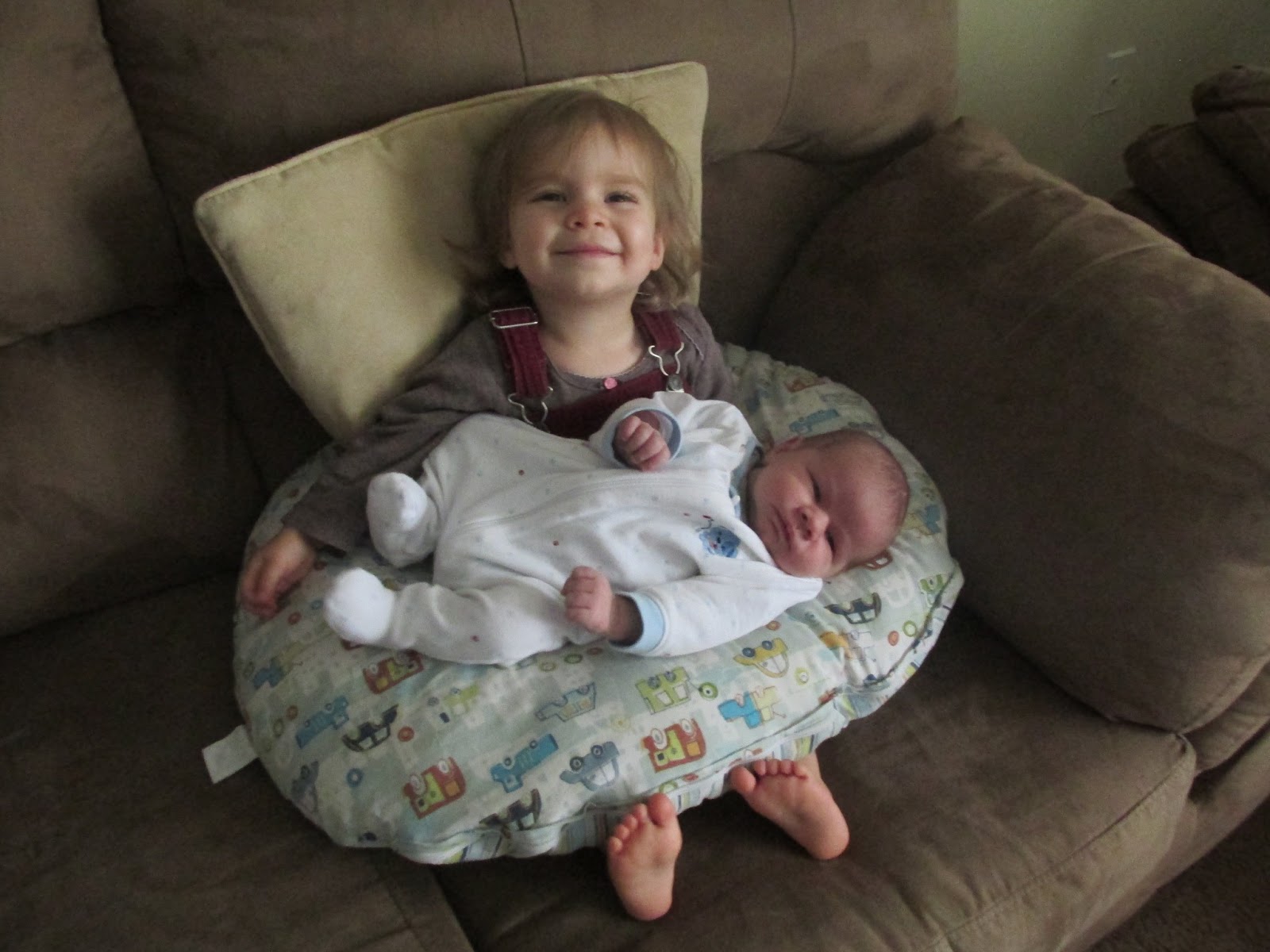
My 19 month old with her baby brother. She recently started using a couple of phrases including "look-at-me" and "I-lub-it." For this picture she was telling me "look-at-me I hold Ben!" and "I-lub-it baby." 
So, after a year and a half of exposure to a language, toddlers can understand quite a bit, but are just beginning to express themselves using the language. And they mostly express themselves in areas that are most important to them, usually related to food, fun activities (my 18 month old loves to yell "Go!" when it's time to go anywhere), or interesting objects (ball, plane, cat, etc).
My 5 year old, who recently learned to say "zebra" instead of "zebwa"(finally).
By the time most children are 5-6 they speak in complete sentences, use mostly correct grammar, have an estimated 6000 word vocabulary, and are mostly considered "fluent." Even after this point, children, teens and adults continue to add to their vocabulary (though the rate slows), and most college graduates have a 20,000 word vocabulary, which continues to expand through adulthood.

What does any of this have to do with living simply?

We cannot expect to become experts in simple, organized living overnight... it takes a LONG time, and we need to start slow.

Step 1: Observing
Our first step in becoming fluent in simplified living, is to observe. We watch others who live the way we want to. We keep our eyes open for homes or displays or showrooms that have the feel we want. We need to become familiar and comfortable with the atmosphere we are trying to achieve, the same way a young infant observes, and becomes familiar with the basic sounds of the language they are learning.

Step 2: Practice the Basics
Try organizing & simplifying one cupboard, one drawer, or one shelf. Work on keeping it that way.

Step 3: Try Combining Basic Principles
Just as a toddler starts to form simple sentences, you can combine basic organization and minimizing principles to form simple systems and routines.
One of my 3 1/2 year old boys wearing his sister's pink ice princess pj pants, because we got behind and all of his pjs were dirty. 
Step 4: Build Fluency
This doesn't happen overnight, but as you continue to build your organizational "vocabulary" you become more familiar with how systems and routines work for you, and you can learn from your early "grammar" mistakes. Very slowly, you will feel more comfortable with your simpler lifestyle.

It takes a child 2-5 years to get a good grasp of their first language. You wouldn't be able to learn a foreign language overnight, or even in a couple of weeks. Start slow, and give yourself time to learn.

PS. As I wrote this post, and prepared to publish it, I realized that the same is true of our children... organizing and simplifying is a foreign language to them too... it will take them time to learn, so we need to be patient and encouraging, and set a good example whenever we can.

15 March 2013

Priorities

You know what they say about the "best laid plans" right?

Yea... that's what has happened with this blog for the past couple weeks. :) I was discussing some of my posts on the phone with my sister, and mentioned some that I had planned. My wonderful husband overheard part of the conversation and explained loud enough for her to hear that I had more important things to work on first.

He was right, of course.

I had been getting caught up in writing and ignoring some of the more important things in my home. So, here is my repentance post, and my renewed effort to live by my priorities.

Identifying Priorities

Keeping priorities straight is a process that requires constant adjusting. It's so easy to get caught up in "fun" things or "urgent" things or just things that appear to be more important than they are. So, how do we keep things straight? The best way I have found is with a personal mission statement. I've mentioned mission statements before in Getting Things Done so today I thought I'd share mine.

Last October, I used the suggestions from Mission Statements for Moms and created this mission statement which addresses my top five priorities.
Emily's Mission Statement
I AM a Daughter of God. I WILL turn to my Savior daily and be a "good and faithful servant."
I AM David's Eternal Companion. I WILL be his physical, emotional, and spiritual helpmeet.
I AM a Mother. I WILL be a loving example as I lead and guide my children to Christ.
I AM a Homemaker. I WILL keep a clean, simple, well-run home, filled with love, where all who enter can feel the Spirit of The Lord.
I AM a Teacher. I WILL teach my children to communicate effectively in both written and spoken language and I WILL teach my children how to learn so they can continue their education and fulfill their personal mission in life.

Repenting
When my husband reminded me that I had more important things to do than this blog, I decided to ask him what I was forgetting. Though he hasn't studied my mission statement much, he explained that while I was focusing on the house, I was neglecting the kids. Going back over my mission statement... he was right. I purposely listed "Mother" before "Homemaker" but I wasn't doing a great job of keeping those things straight.

Even within the mission statement, there is some overlap. Getting basic schoolwork done is more important than having a perfectly organized house, and feeding my children is more important than going on lots of fun dates with my husband. My deep-cleaning & blogging fall somewhere in the category of Homemaker... but actually below some of the jobs within the role of Teacher.

Moving Forward
I may or may not be posting a ton on this blog in the very near future. As I put the finishing touches on this post, I am anxiously awaiting the onset of labor, and the birth of our seventh child. Obviously, my babymoon will not involve a ton of home organization, so I won't have as many "show & tell" type posts. We may have some other exciting adventures in the near future that I would definitely be blogging about if they happen. :) I'll try to keep posting!

(And sorry for the lack of pictures in this post... I hope you understand.)

04 February 2013

Get Real

Childhood Dreams
When I was a child, I often dreamed about what my life would be like when I grew up. Sometime during the later grade-school years, I created my “life plan.” This plan detailed how many children I would have, what their names would be, when they were going to be born, where we would live, how much money we would have, etc. I planned to have twelve children, and name them all after characters in my favorite books, which at the time included The Boxcar Children.
We were going to live on a farm where we could own a few horses, breed and raise Rottweilers, and go star-gazing every night. I had detailed floor plans of our house and barns and even had a list of furniture I was going to purchase to fill my children’s rooms (including cool plastic toddler beds, bookcases, toy-boxes, and child-size tables & chairs).

Then I grew up.

I am currently expecting our seventh child, so I’m more than halfway to twelve… but almost nothing else from that plan has happened or will ever happen. I got married earlier than I had anticipated (20 instead of 23), I obviously had no choice in the gender of my children, and none of them are named after fictional characters from children’s literature. (One of the twins has Henry as a middle name, but he is named after a great-grandparent, not after Henry in The Boxcar Children.) I recognize now that animals are a LOT of work. While I enjoy riding horses when I get the chance, I have no desire to own one or care for it. I raise children instead of dogs, and frankly I’ve discovered that I’m not really a pet person. I would still love to go star-gazing more often, but I’m not sure that the farm life is for me. I love the suburbs and our trick-or-treating friendly neighborhood. The floor plans I drew as a child would likely not pass any building codes and had no interesting (and very little functional) architecture. My taste in furniture and desire for race-car and princess toddler beds has definitely changed as well.

Adult Aspirations
When I was in college, I majored in Marriage, Family, and Human Development. I took courses on infant, social, cognitive, and language development, as well as parenting, marriage enhancement, and family finance. For several of these courses, I compiled binders full of parenting articles and created plans for how I would raise my children—what I would teach them, how I would train them, and how I would make them behave.
Walking at graduation, 8 months pregnant with my first.

Then I became a mother.
My first born, K, 30 May 2005

Reality is so different than fantasy, isn’t it?

Adjusting to Reality
These fantasies never came true, and that’s okay. Creating fantasies and dreams helps us to find something to work towards. 
"Shoot for the moon. Even if you miss it you will land among the stars." - Les Brown
However, if we are forever dreaming and planning our fantasies, we can miss out on beautiful things from the present. There is a wonderful post at ZenHabits about Savoring Life. It can be difficult to savor life when we are constantly reminded of all the things we are not doing that we believe we should be. When our lives are cluttered with unfinished projects (or un-started ones), and items that our "fantasy self" would use... but our "reality self" just won't, we cause ourselves unnecessary stress.

If you truly want to become a master baker... start learning now. Make time for it. Put other things away and purge in other areas so that you can be free to bake as often as you can. Personally, my fantasy self would make homemade bread several times a week... my reality self is not good at baking, doesn't enjoy it at all, and would rather sew a quilt... so I guess I can pass on my pastry flour to someone who would enjoy it. :) Maybe then I can quit fantasizing about homemade bread, and enjoy my quilting with less guilt about not being the perfect homesteading wife. :)
Quilt squares that ended up in the quilts on my girls' beds.
My mother also sews, and when my siblings and I were growing up, she made our Halloween costumes most years. She always made high-quality garments and the costumes are still in great condition 20+ years later. I always thought that was awesome, and wanted to do the same for my children. One year, when I had
three children, I made themed costumes for my children, my husband and myself.
Pooh and Tigger - 2008
They turned out perfect, we got a lot of compliments on them that year, and we have used at least one of those costumes every year since.
Halloween 2009 with Piglet, Kanga, Thing 1, Tigger, a princess, Thing 2, and Eeyore
But, it was a lot of work, and I didn't really enjoy the process, and I've never done it since. In fact, now that we live close to my parents, my kids choose their Halloween costumes from Grandma's collection.
Halloween 2012 with a butterfly, Piglet, a cowgirl, a pirate, Tigger, and a princess.
Even if we didn't have access to Grandma's costumes, at this stage, I would rather buy costumes instead of sewing them myself.

Move On
My fantasy self from my childhood has changed. Even my fantasy self from 3 years ago has changed. And that's okay. It's time to grow up, move on, work on current goals and dreams, and let the old ones go... along with the clutter that goes with them. 

28 January 2013

Good Enough

I have a confession. I have a character flaw that I have been working on correcting for several years.

I am a perfectionist.

This probably comes as no surprise to those who know me, especially close family members. But I willingly admit it now, and that is the first step in correcting this flaw, right?

Now, before we go further, I would like to clarify something. Being perfect is not necessarily a bad thing. After all, we have been commanded to be perfect, even as our Father in Heaven is perfect (Matthew 5:48). But there are two problems with being a perfectionist:

1. Perfectionists often procrastinate because they don't want to start a project if they aren't sure they can finish it perfectly.
2. Perfectionists get consumed in a project, and continue to try to perfect things long after the benefits of perfecting the project have past. 

Procrastination Fear
In the bible, the parable of the talents tells the story of three servants who were each given a sum of money and told to do what he could with it (Matthew 25). The servants who received 5 and 2 talents each worked hard and doubled their Lord's money. The servant who received only one talent must have been a perfectionist. He was so fearful of losing his one talent that he hid it and did nothing at all.

When the Lord returned and reckoned with the servants, the two who had doubled the money were praised: "Well done, thou good and faithful servant." But the servant who had hid the money in fear was rebuked: "Thou wicked and slothful servant." Even if we can't do things perfectly, we should still make an effort to do something.

Keep Moving
The point of the childhood game of "Hot & Cold" is to find a hidden object by following the clues "hotter" and "colder." One key lesson we can learn from this game is that it is impossible to find what we are looking for by standing still. Often, when we work to downsize and organize our life, we may find ourselves further from our goals. That's okay. This feedback is essential to finding what we are actually looking for, and we will often need to move in the wrong direction first, so that we can discover that it is, in fact, the wrong direction for us.

Economics of Organization
I already admitted to being a perfectionist, and now I will also admit that I am a bit of a numbers nerd. One of my favorite classes my freshman year in college was economics. The most applicable to life lesson I learned from that course was the concept of marginal cost & marginal benefit. In simple terms this means that at some point the extra cost of more work, will be more than the extra benefit gained from that work.

In organizing, this means that at some point, the energy required to further organize, or to maintain a high level of organization is more than the energy or stress saved by organizing. In some cases, the energy required to maintain "perfect" organization actually causes more stress.
Example: girls' hair accessories. Potentially, I could buy some nice drawer organizers, and have one section for hair rubberbands, one for bows, one for headbands, one for flowers, etc. This wouldn't take me very long to actually sort and organize. However, my girls don't care. If I insisted on keeping it organized it would only add to the stress in our house, and cause more contention. And then it would be a waste of money to buy the organizers.

Organize Until it's Good Enough, Then Stop. 
Instead of stressing over keeping the hair accessories "perfectly organized," we have chosen to simply make sure they all stay in the same drawer. The same principle can be applied to our toys. We have two toy bins for "cars & trains." At one point, one of my children wanted to sort these into "cars" and "trains" and spent quite a while separating them and telling all of her siblings that one of the train table drawers was just for "trains" and the other was for "cars." The sorted toys stayed sorted for about 10 minutes.
For a more adult example. In our kitchen, we have a drawer for spatulas & large spoons & other random handheld kitchen gadgets. This particular drawer itself is not organized in any way. Everything that belongs in that drawer is simply thrown in there. Why? Because it works. As long as the drawer is following the 80% rule, there is no point stressing over placing the spatula on the left side of the drawer, and the can opener on the right side.
Also, on the minimalist side of things, purge until it's good enough, then stop. I could get rid of all but one sauce pan in my kitchen. It would be possible. But minimizing that drastically would cause more stress as I tried to only cook one-pot dishes, or pre-cooked rice and then steamed the veggies. The point of this blog, is to end up with less stress, and less work if possible. If keeping a full set of pots and pans will make cooking dinner less stressful... then I'm going to keep my full set. :)

If It Works, Don't Mess With It.
After reading through several of my past posts, and seeing pictures of how little we have of some things, I know several of you have thought that there is no way that would work in your family. That's okay! If your current method of storing, playing with, and picking up toys is working, then don't spend the energy to change it! If your current stockpile of fabric for sewing projects makes you happy, don't get rid of it! Don't change things that are working for you.

However, when you notice something is not working, when it's causing stress and frustration, that's when it's time to make a change. That's when it's time to try something different. Maybe the something different will take you in the wrong direction, and you'll feel "colder." In that case, it's time to try something else, gradually getting "warmer" until you find something that works. Then when you find something that works, use it until it doesn't work anymore, and then change it again. Don't worry about finding the "perfect" method, because it doesn't exist.

25 January 2013

Emergency Mode: Another Benefit of Less

I would like to apologize in advance for the lack of relevant pictures in this post. The only relevant pictures I have are too private to share. But, I've been told that blog posts are boring without pictures... so I have included some random ones. :)

Allowing our "servant" to vacuum the floor while we watched football.

Nearly two weeks ago, just a couple days after my "disaster to company ready" experiment, we entered Emergency Mode. After struggling with feeling crummy for several months, and feeling especially bad for a couple of days, I took my husband to the Emergency Room late Saturday night. He ended up being diagnosed with severe anemia caused by chronic blood loss, and was admitted to the hospital for two days, where he received two blood transfusions with a total of 4 units of blood, as well as numerous tests to determine the cause of the blood loss. It was a stressful couple of days, as I'm sure anyone who has logged hospital time with a loved one can attest to, and I pretty much checked out of home life for 48 hours, everything except being a mother to my children.

Sometimes I seriously wonder why we bother buying them separate beds...

When we made the decision to go to the emergency room, I immediately called my mother and asked her to stay with our kids. They were already in bed asleep, and the house was already picked up and wiped down, because that's part of our normal routine. It was Saturday night, so we had also packed up the toys from the rotation and put everything in the garage for the weekend. My mom slept on our couch overnight and helped the kids get started on breakfast early Sunday morning. After my husband was admitted to the hospital and his blood transfusions started around 5am, I got about an hour of sleep in a hospital chair, then drove home about 7:30 to help the kids get ready for church. Thanks to our prep the night before, all the kids Sunday clothes were ready, the girls' on their dresser, the boys' hung in a group in the closet. My mom ran home to get herself ready and I quickly changed the younger kids and loaded everyone into the car. My mom returned about 8:30 and took the kids to church for us, while I went back to the hospital. Our wonderful church family helped my parents and my kids were able to keep some sense of normalcy after waking up to learn that Daddy was in the hospital.

Having fun on the "safari truck" at the zoo.

The kids spent Sunday afternoon, evening, and overnight at my parent's house. Because our house was picked up and everything was put where it belonged, with the help of my older girls, my mother had no problems packing overnight bags for my kids and taking the essentials back to her house.

Playing "restaurant"

My mom was also able to bring the kids to visit Daddy on Sunday afternoon, and I left the hospital for a couple hours Sunday evening to just be with the kids.

My birthday last year.

I spent Sunday night in the hospital, at my husband's side, and attempted to sleep as much as possible. Monday morning he was feeling much better, and told me to go be with the kids again while his second transfusion was going. So, I spent a few more hours at my parents' house, just enjoying spending time together. I arrived at the hospital in the afternoon and we were excited to learn that he would be released that evening.

Memories at the beach are always better than more toys. :)

Arriving back home was a bit surreal after being in the hospital, but it was wonderful to walk in the door and see our clean & put together home. My parents dropped off our kids and dinner, and we settled in for a movie night together as a family.

DIY facepaint at the Children's Museum

Since the hospital stay, we have had a few follow-up appointments, and will continue to have more, with the possibility of surgery in the near future. We have had wonderful family & friends continue to bring us meals, and watch our kids for us, which has also been an enormous blessing. One of the best parts of this whole adventure is that I have felt like the house has almost run itself. As long as we run through our list of dailies at least once per day, we have been able to keep the stress at bay. The toy pick-up & put away doesn't take very long when everyone is working and everyone knows where everything belongs, and when there isn't much to put away anyway. This has been especially important as my emotional health and physical energy have been recovering since the hospital stay, and I haven't had much energy to devote to household chores.

Traditional choosing/cutting of the Christmas tree.

I have spent some time recently wondering what my house would look like these days if my home looked like it did several years ago, with lots of clutter and open storage...

Creativity at it's best... I'm pretty sure Buzz Lightyear was supposed to represent an angel in this Duplo nativity scene. 

And I am grateful for less to worry about these days, and less to care for, and less to distract me from the things that REALLY MATTER.

22 January 2013

Do You Love It?

I grew up in a family of seven children, so being frugal and thrifty was always a part of life. Whenever my mom helped us go through clothing while getting ready for buying school clothes, she was always encouraging us to get rid of anything we didn't love. We each had very small wardrobes overall, a few pairs of pants, a handful of shirts, and a couple of dresses or skirts. "You only wear what you love anyway." she would tell us. Since the oldest four of us were all girls, in high school we were able to wear each others' clothes a bit, and expanded our wardrobes a little that way, though we often had different styles, and one sister is notably taller than the rest of us, so she couldn't share as easily.
My family 11 years ago, when I was in high school.
The two sisters standing in the back had borrowed their dresses
from the older two in front (I'm the one sitting on the left).

But overall, my mom was right, at least for me. I frequently found myself reaching for the same 3-4 shirts, and always searching for the same 1-2 pair of pants... frustrated when all my favorites were dirty and I had to wear something else. I still notice this in my closet now. I hang all my pants on the left of the closet, and all my shirts on the right. When I hang up my clean laundry, I always put the clean things in the middle, right between the pants & shirts. When I pick out clothes to wear, I try to start at the outsides of the closet. That would mean starting with the things that haven't been worn in a while. Yet frequently, I end up grabbing items from the middle of the closet, or frustrated that my favorite shirt hasn't made it back through the wash yet (and it's only been 3 days).
I just finished hanging up the adult darks, so this is literally my entire wardrobe... maternity and otherwise. The only things not pictured here are my pajamas, underclothes, the outfit I was wearing while taking the picture, and the shirt I had worn the day before when the laundry was being washed (I was wearing the same pants as the day before).

Unclutter
The lesson I learned from this is that we shouldn't clutter up our closets or our lives with things we don't love. As I was writing the blog post about my sister, J, I asked her a few questions about her home now. Here's an excerpt from her response:
You know I don't sew or craft at all, so I don't keep any of that in my house. I also don't keep very much in storage - mostly holiday decor, and even that wouldn't be there if I didn't love decorating.
I've stopped keeping things in my to do pile that need to be "altered" or fixed. If I can't fix it within a few minutes with the resources I have now, it's gone. Projects I've held onto for years I have just thrown out because I've realized it will cost me more stress than the completed project will bring me happiness.
While J doesn't sew, I do. I have discovered that I love quilting. I have been trying to find more time to spend on quilting. But, I don't like sewing clothing. I can, and as I mentioned in a previous post, I once sewed our entire stash of cloth diapers, but I don't enjoy it. So, I can get rid of apparel-type fabric that would not be good for quilting, and I try to only keep fabric & supplies for projects I'm in the middle of. (hmmm... I think I need to go through some boxes and purge again...)
The pile of fabric for the quilts I'm working on for my boys.

Too Many Loves
We should only surround ourselves with things we LOVE. Often this is difficult because there are lots of things that sound good, or that we believe we love. Much like my children claim that every toy or stuffed animal is their "favorite." When we have so many "loves," each one is diminished in value.

It can be difficult to identify the things and hobbies we truly love. Here are some ideas to help discover those loves.
 - Make a list of things you want to do
 - Walk around your home and write a list of projects you want to do as you see the materials you have collected for those projects.
 - As your list grows, ask yourself if you will truly enjoy the process of doing these things.
 - Ask if the finished project will enrich your life. Will you be glad you did it? Will you be glad to have it?
 - How long will these projects take. Remember, it is impossible to find the time for all of them, and you will most likely find new project ideas in the future (thank you Pinterest). Choose your absolute favorites, then let the rest go.

When we were house-hunting a couple years ago, we walked through dozens of homes. Several homes were appealing, and there were some aspects of each home that we loved, and some features that we didn't love. Obviously, in the end, we could only choose ONE house. Our real-estate agent gave us a great piece of advice: find two favorites. Every time you enter a home, as you look around, ask yourself if it is better than either of your previous two favorites. If it is better than one of them... it becomes a part of the favorites, and one of the previous homes gets kicked off the list. If it is not better than either of them, forget about it. Eventually, you'll end up with two homes to choose between, instead of 20 or more.
Our house - image courtesy of Google StreetView

This can be a difficult process, as everything seems to have its pros and cons. But, with practice, we can learn to step back from the emotions enough to make an objective decision between hobbies, projects, & STUFF, and determine our actual favorites, and our true loves.

True Cost
Remember yesterday's post on true cost? Everything we choose to do or have costs us in some way... time, space, money, or all of the above. When we are simplifying and trying to reduce our stress, we should only be keeping around the activities and "stuff" that we absolutely LOVE. We can find more happiness and joy spending time and energy on things we LOVE when we are not mentally cluttered by things we enjoy less, or don't like at all.

The Moral of the Story
-Keep what you LOVE
-Pass on what you don't love, or what does not fill you with joy.

21 January 2013

True Cost

Every item in our lives has a cost associated with it. When we purchase something at the store, there is a price-tag on the item, and we pay the monetary value of the item. But there are other, frequently on-going, costs of everything we bring into our lives.

Let's use a small knick-knack as an example. Here's a statuette my mother-in-law gave me when I gave birth to my first daughter.

This gift actually cost me nothing in terms of money, but it still has costs associated with it. First, I have to find space for it. With limited space in our house, I don't have many places to display knick-knacks, and every display space is more precious.

Also, because this statuette is on display, it collects dust and cobwebs, which must be removed to keep my home from looking like a haunted house.

In the 8 years since I received this gift, we have moved 8 times. This means I have had to spend time carefully packing the statuette so that it wouldn't get broken in storage or transit, and it has taken up space in boxes or bins. Also, I have had to find a new place for it in each of our homes, or I have had to leave it in storage, which still takes up space.

And, if my children ever knock it down and break it. I will need to spend time fixing the statuette, or pay to replace it, or simply go without.

So, while the gift of this simple statuette didn't lighten my wallet, it has cost me time and space over the past 8 years. This may seem like a small thing... but how many gifts have I received over the years? How many things do I need to take care of like this? I have chosen to keep this statuette because it is special to me. It reminds me of my motherhood and how special and precious my little ones are.

Other such gifts have long since left our home. Once we were given a doll with a beautifully hand-crocheted dress. If I remember correctly, it was a wedding present. However, it was from a woman I had never met, it took up space we didn't have in our first apartment, and thanks to the incredibly ruffled yarn skirt, it collected dust faster than any other knick-knack we had. The cost of maintaining and caring for the doll eventually outweighed the enjoyment we got from it, and we passed the doll on.

This concept doesn't just apply to display items or knick-knacks. Before you bring anything into your home, or when you are purging items, consider the true cost of each item. Think of the time spent on maintenance, the space required, any ongoing monetary expenses (such as dry-cleaning). Then think of the benefits you receive from the item (does it make you smile, or bring you joy? does it help you accomplish a necessary task?), and decide if the item is truly worth the costs. Especially when we are limited on time, space, and finances (who isn't?), hanging onto items that cost more than they are worth, simply adds stress to our lives. And if you do have unlimited time, space, and finances... please share some with the rest of us.

11 January 2013

Be True to Yourself

At one point, a sister of mine refused to wear hand-me-down clothing. J also didn't want to shop at discount stores, or from the clearance racks. She spent a lot of her hard-earned money shopping name-brand, in-season clothing. Fashion was pretty much her favorite thing ever.
J in high school
J with another sister, S.

When J got married, and especially when she became a mother, her priorities shifted. She realized that she would rather spend more time with her husband and son than working to earn the money for her expensive wardrobe.


J still loves fashion though, and dressing nicely and in-style is still important to her. Instead of giving up the fancy wardrobe, she simply gave up the labels & price-tags. She has become one of the best bargain-hunters I have ever met. She has also simplified her wardrobe and chooses to embellish her relatively few outfits with lots of accessories.


In addition to her fashion sense. J loves to surround herself with beautiful, clean, simple, fashionable things. Again, budgeting became a challenge when J got married, and she found herself unable to purchase all the fancy furniture and decor she wanted.

Rather than accept a life of cheap, run-down furnishings, J improvised. She kept her love of beautiful things and figured out how to find or create things to fit in her home, for a much smaller budget.
I rarely buy anything at normal stores anymore. It's thrift stores for everything, unless it's toiletries or something. I've noticed that no one can tell the difference anyway! -J

She found solid wood end tables for ridiculously cheap... from a craigslist 5 hours away from her home (and then had my parents take them to her when they visited a month later), and then refinished them with a bit of sandpaper and spray-paint so they would match the decor of her house. She found old lamp bases at a garage sale for a few dollars each and spray-painted them as well, and fitted them with new lampshades which she bought on sale, and with coupons.


J's tiny 1065sq ft, 2-bedroom row house is full of stories like this. Her simply furnished, beautifully decorated, tiny home always inspires me.


While we may not have the budget or space for fancy things, we don't have to change ourselves. There are ways to keep our own individual identities and simply change the way we approach the things that are important to us.

10 January 2013

Minimalism IS... (and is NOT)

Minimalism is NOT about limiting yourself to a specific number of belongings.

Minimalism is NOT about living in the woods as a hermit.

Minimalism is NOT about depriving yourself of needs or wants.

Minimalism is NOT about giving up things you care about and enjoy.

Minimalism is NOT about doing everything the "old fashioned way."

Minimalism is NOT anti-consumerism, or even save-the-planet-ism

Minimalism IS about removing distractions and time wasters.

Minimalism IS about spending time with people that matter.

Minimalism IS about finding fulfillment in things and people you care about.

Minimalism IS about finding time for hobbies you enjoy.

Minimalism IS about keeping life simple and easy so you can enjoy it more.

Minimalism IS about people and relationships, especially the relationships with friends, family, yourself and with GOD.

07 January 2013

Budgeting Space

Money
If you ask, read, or listen to any financial expert, they will likely tell you that the key to financial stability is to live within your means. This means that you cannot spend more than you make. They key to becoming wealthy is living well below your means. Most experts recommend something similar to the 10/10/80 rule.

They usually recommend giving 10% of your income to charity. This can be to a religious organization, an organized charity of your choice, or to homeless people on the street. It doesn't matter who you give it to, 10% should be gifted to others.

The next 10% should be saved. Gifted to yourself to use for retirement or an emergency.

Then the tricky task is to fit your living expenses into the remaining 80% of your income.

Space
Organizing gurus will give you a very similar statistic. For a storage space to be functional, it should not be more than 80% full. This applies to bookshelves, pantries, cupboards, filing cabinets, closets, toy bins, drawers, garages, and anything which needs to be accessed. Some long-term storage bins or boxes can often be packed to capacity because they will hold up better if the contents of the container are supporting the sides and top, but the majority of spaces should be no more than 80% full.

Setting the Budget
While it might be nice to have a limitless income, and limitless space, the fact is that we don't. Increasing our income might help us spend within our means, but often it simply increases our spending. Likewise, increasing the space we have available might help us fit all our junk in while still feeling spacious, but often it allows us to accumulate more junk.

Just as God has given us different incomes, He has also blessed us with different size homes. But we all need to work with the resources we have been blessed with. So, we work on setting limits for ourselves within the finite boundaries of the space we have.

Define a Space
This is similar to breaking down your budget into categories such as "groceries," "entertainment," and "auto."

I currently have 3 file drawers. I actually have a couple of drawers that I could potentially use as file drawers if I needed to, but I have decided that 3 enough. These drawers hold 1)Finances & other Important Documents (such as copies of government identification and medical information), 2)Instructions & Warranties (including the owner's manuals for most appliances and gadgets), and 3)General Reference. The general reference drawer is where I put all those random papers that I think I might use or reference in the future, but I don't need right now (like the article I found from my college days on teaching teens about chastity).

Don't Exceed 80% of Capacity
Just as we rein in our spending when we are getting closer to the end of the month, we need to purge before we exceed our budgeted space.

When these drawers start to get tight, and it is difficult to pull files or papers out of them without others coming along for the ride, I've more than exceeded the 80% rule, and it's time to dejunk. Most of the time, this simply involves me flipping through a few files and tossing (often shredding) paperwork I no longer need. Like the instructions & warranty for the curling iron I got rid of a year before because it broke and I replaced it.

Shift if Needed
Sometimes we realize we didn't originally budget enough in "groceries," but we gave ourselves too much space in "entertainment." Then we make a shift.

Occasionally, I can't get rid of enough with just tossing things I don't need. So far, this has only happened with the Financial bin. In that case, I can still get the drawer back to the 80% rule by moving some of the files out of the bin. With finances, there are often documents I need to keep, but don't actually need to get into on a frequent basis. These include documents from previous employers (like the receipt that proves my husband returned the company issued laptop before he left), previous tax returns, and other accounts that have been closed, but it's better to be safe and hang onto some of the documentation. These "dead files" are moved to a long-term storage space, and my drawer is back to 80% or less (since I will be adding to it as I use it).

Keep the Overall Budget
Just shifting the "stuff" doesn't fix everything though. When my long-term storage space gets too full to neatly stack the boxes, or access things I need... it's time to dejunk that.

Each and every space should be kept less than 80% full for maximum efficiency.

Theory in Practice
Later this week I'll do a demonstration type post with before and after pictures of an area or two that I'm currently working on. But tomorrow's post will be the Toy Rotation!

05 January 2013

Shifting Priorities

Piggy-backing yesterday's post, I wanted to discuss how priorities and goals change in different seasons of our life.

The Back-story
When my husband and I were first married, we were both students, both working part-time. Just before our second anniversary, I finished my bachelor's degree approximately one month before our first child was born, and quit working when I was about 6 months pregnant. We had decided very early on in our marriage that I would be a SAHM when children joined our family. This put a lot of stress on my husband as the sole bread-winner, while he was still in school. He started working 30 hours per week, while still attending school part-time. Finances were still very tight though. When our second child made a surprise appearance almost exactly a year after her sister, the budget became stretched very thin. It was my job as SAHM to find a way to make the budget work.

When our first daughter was born, we were gifted a year's supply of diapers from a grandparent. That year's supply ran out the same time our second was born, and suddenly we had to pay for two kids in diapers. After a few months of that financial stress, I decided to try cloth diapers. With our limited funds, I could not afford fancy diapers, but after discussions with some friends, I was able to start us off with a cheap supply of cloth diapers. With the money I was now saving by not buying disposable diapers, I started slowly buying fabric and putting my sewing skills to work by making fancier diapers. By the time our third daughter was born 19 months after our second, I had a good supply of cloth diapers, and all three girls were cloth diapered full-time. Cloth diapering continued full-time even when our twins were born. I already had a good supply of diapers, and they were still in fairly good condition, even after going through 2-3 kids. I did have to sew a few extra diapers, since I hadn't originally made enough of the smaller sizes to accommodate 2 kids in the same size together.

The Shift
When the twins were a year old, things started to change. My husband was now nearing the end of his Master's degree, and he had a well-paying full-time internship. Our boys were much bigger than our tiny girls had been, and some of the larger diapers seemed to shrink a bit over time. The largest sizes I had made, which fit my oldest when she was 3, were now very snug on my one year old twins. I told my husband it was time to make some larger diapers, and I started preparing to source the material.

One night my husband was quietly listening to me ramble on about diaper fabric when he interrupted me. "Do you have time for that now?" he asked. This confused me a bit, so he elaborated. He explained that when we started with the cloth diapers, we were desperately trying to find a way to make our tight budget work. At the time, our finances were tighter than the demands on my time. Now, however, our finances were still snug, but the demands on my time were much greater. I no longer had two small children who napped consistently while I sewed... I had 5 small children, one of which I was teaching to read, and two of which no longer napped. He suggested that I find a way to fit disposable diapers into our budget again. We discussed our options and decided that it would be a better use of my time to cook from scratch more to save some money on our dining out budget, and then spend money on the bigger disposable diapers we would need for the twins.

Let it Go
Sometimes our priorities shift like this. It's not a bad thing. Life goes on. We should not live in the past, but rather learn from the past and recognize that the present is different. Just because we once thought it would be cool to own all 10 seasons of Friends on DVD, doesn't mean we have to hang onto them when we realize we don't want our children watching them and they don't fit in the DVD binders and the only other option is to put them in storage.

It's okay to let things go in favor of extra mental and physical space.

04 January 2013

Getting Things Done

Several years ago I read the book titled "Getting Things Done" by David Allen. The book is geared towards business professionals and gives detailed instructions on how to process an inbox and current projects and determine what you should actually be spending your time on, and specifically the "next thing" to do.

I gleaned a lot from the book, and it's a good read, but motherhood involves way more "urgent" interruptions than most business professionals deal with on a daily basis, and I found parts of it difficult to apply to my current life. However, there were several things learned from the book that have stuck with me in the 4-5 years since I read it.

Keep Your Actions Consistent with Your Priorities
Don't spend your time on things that are not important. This is much easier said than done. And of course, the first step in this process is identifying what your priorities are. I highly recommend the series on Mission Statements for Moms from Kat at Inspired to Action. Once you've identified your priorities, it's time to start analyzing your day-to-day activities. As many times as you can throughout the day (maybe set an alarm for every hour) stop and ask yourself, "Is what I'm doing RIGHT NOW important? Am I focusing on one of my top priorities?" It's easy to get caught up in menial tasks that do not actually support our priorities. Also, if you are doing something that fits with one of your priorities, make a note of which priority you are focused on at that moment, and after a couple of days analyze which priorities you actually spend the most time on.

I am one that can easily get caught up in housekeeping. I LOVE having a clean, uncluttered space, and I frequently spend more time picking up and organizing than I should. While homemaking is one of my personal priorities, motherhood is a higher priority for me, and I don't spend nearly enough time focusing on my children, reading them stories, listening to their thoughts, or helping them with projects.

Be Okay with the Things You Are NOT Doing
This is an important step for aspiring minimalists. A mile-long to-do list can stress anyone out. There is rarely enough time in the day to accomplish all that we would like to do, or feel we need to do. David Allen specifically recommends writing a "project list" of all the multi-step projects we are working on, or would like to do. Then he recommends moving projects we don't plan to work on right now to a "Someday/Maybe" list. He guesses that a typical person could easily have 100+ things on a "Someday/Maybe" list.

When I created my project and someday/maybe lists, I realized that it would be impossible for me to complete everything on my lists in one lifetime. Just looking at the project list of things I wanted to be working on, I realized that I would never have enough time in my day to complete these projects on any kind of schedule, even if I didn't have children and was able to spend 40+ uninterrupted hours per week on these projects. Currently, I can count on about 4 hours per week for my own personal projects... and that is usually full of interruptions.

Understanding that I would never be able to do everything on my list, it was time to prioritize again. This is approximately the time when I got rid of my old t-shirt collection. I knew I would never have time to actually make the t-shirt quilt I wanted to make, and there were dozens of other projects on my list that I would rather spend my time on instead. I started asking myself questions like, "What do I want to spend my time on?" and "What finished projects do I want to have in my house?" These questions helped me eliminate project ideas that I determined would never actually be completed. Once I knew a certain project would never be done... it was easy to get rid of an materials and supplies I was hanging onto for that particular project. The t-shirts left, some broken furniture I intended to restore left, yarn that I didn't like the color of left, and several other boxes & bags of crafting things left, along with several pieces of memorabilia I realized I didn't actually want to display in my home.

There is great peace in seeing the to-do list shrink. In understanding that without these things around, you won't be constantly reminded of what you could be doing, or making mental lists of the things you might want to do someday. Instead, live in the present. Spend your time on things that you want to do, and surround yourself with things you enjoy that actually uplift you.

02 January 2013

Use it Up, Wear it Out, Make it Do, or Do Without.

I'm sure we've all heard this old saying before. It was a way of life during the depression, when resources were extremely scarce. Now, in our days of excess consumerism, the adage is still extremely useful.

Use it Up, Wear in Out, Make it Do
Most of this saying refers to using the resources we already have to fill needs. Use the food in the fridge and pantry to figure out what to make for dinner, instead of running to the store, or picking up fast-food (or ordering pizza, which is admittedly our biggest weakness). Wear the clothes in your closet until they are worn through, rather than buying new things. Then when they are worn, patch them up and get more life out of them... if you have the materials to patch them already. When you have limited tools, use the ones you have to complete your projects. When you only have a 2 cup measuring cup, but need to measure 3 1/2 cups of oats... you'll just have to use the cup twice. When you're trying to make cookies, you'll have to wash the measuring cup between the wet & dry ingredients.

Saving Time
Often we think, "Oh, but if I have to wash the measuring cup in the middle of cookies, I'll be wasting time." But look at the bigger picture. If you do have two measuring cups, and use one for wet ingredients, and one for dry... then you have to wash two measuring cups when you finish, instead of one in the middle and one at the end. You're not saving any time, it's just shifting to a different part of the process. And, you'll have to store two measuring cups.

Pass it On
This is one line I believe should be part of the old adage. Just because you have something, and could use it, doesn't mean you should. I once accumulated a large supply of baby cereal and jarred baby foods before I discovered that my twin boys refused to eat any of it. This presented me with several choices: engage in a power struggle to force my boys to eat the food so it wouldn't be wasted, try to convince my older girls to eat the food (tried it... they hated it too), throw the food away, give it to someone who needed it. Around Christmas-time we ended up taking our entire baby food stash to Jiffy Lube because they were collecting food and diapers for the local food bank. The staff and Jiffy Lube thought the stash was the biggest donation they had seen all season, and handed my husband a discount card for 17% off oil changes for life. I can guarantee we get more use out of that discount card than we would have out of the baby food, and the food was passed on to a good cause.

As another example, I used to collect t-shirts. Girls' camp, church youth excursions, family vacations, school functions, etc. I rarely wore the shirts more than two or three times, but I didn't want to get rid of them. Shortly after my third daughter was born, I decided to make a quilt out of the t-shirts. Then my kids could see all the places I'd been and the things I'd been involved with, right? My husband eventually helped me find a different solution. I was the mother of three small children, I had many other projects on my plate, those t-shirts took up storage space we desperately needed, we already had cozy blankets and quilts that we loved, I didn't have time, space, or need for a t-shirt quilt, or space to store the materials until I did have time (which would probably never happen anyway). Instead, I pulled out my camera, took pictures of each shirt, front and back, and donated all the shirts.

Do Without
This is the most important part of the saying. How often do we hold onto something, or buy something because we think we need the item? I will admit that I often fall into this trap. We need more things because we have more children, right? Not necessarily. They share and take turns, and while it is helpful to have more than one princess dress-up... we don't have to have 4. Rarely do the girls ALL want to dress up as princesses at the same time, and when they do... they learn to share... we can do without.

In my kitchen, I have a cheese knife that I LOVE. We eat a lot of cheese in our house, and the cheese knife is nearly always in the sink or dishwasher and rarely put away in the drawer. I have mentioned several times that I would love a second cheese knife. I actually considered buying myself a second cheese knife when I bought one for my sister as a wedding present. I didn't end up getting another one and guess what? She's been married for 5 years now and I still don't have a second cheese knife. I would never get rid of my cheese knife, and if it ever breaks for any reason, I will definitely be replacing it... but I don't actually need a second. My husband told me that he nearly bought me a second as a Christmas present once, because he was also tired of washing it every time we needed to use it... but then he realized that if we had two cheese knives... they would both be in the sink constantly, and we'd still have to wash one to use it anyway.

On the other hand, we once stayed in the basement of some close friends for about 4 months. It was a temporary living arrangement and we only took the bare essentials with us for the stay. I brought my beloved cheese knife, but had to leave my KitchenAid mixer. The basement kitchen was stocked with some basics, and had a small hand mixer. After 4 months of frustration with the hand mixer, and frequently avoiding cooking or baking because of the darn thing... I determined that I DO need my KitchenAid. I missed it nearly every day and wished I had found a way to bring it with me. Coincidentally, during that same time period, I determined that I did not actually need my large electric griddle, or my set of five mixing bowls (two did just fine), or my 3 different cheese graters (one hand-held was just fine).

The Moral of the Story:
- Use what you already have, instead of going out to buy more.
- Pass on things you don't need, don't use, or that could get more use from someone else.
- Try going without something to see if you actually need it, or if it's something you don't even miss.